
March 26, 2026, 13:14
Where does influence actually happen?
Murray Legg
New research confirms what we've been saying for years - the channels where creators operate are bigger than search. So why are most marketing budgets still stuck in Google's checkout lane?
Here's a thought experiment. You're scrolling Instagram and a creator you follow shares a skincare routine that catches your eye. You save the post. Later, you mention it in a WhatsApp group. A friend says she's tried the product and loves it. That night, you Google the brand name and buy it.
Now, which channel gets the credit in your marketing report? Google. Every time.
This is the attribution problem that has plagued influencer marketing for over a decade. And this week, Rand Fishkin - the widely respected founder of SparkToro - published new research that finally puts hard numbers behind it.
The data behind the gut feeling
Working with Similarweb's clickstream panel, Fishkin analysed the 5,000 most-visited websites across mobile and desktop, categorised them, and mapped where people actually spend their time online.
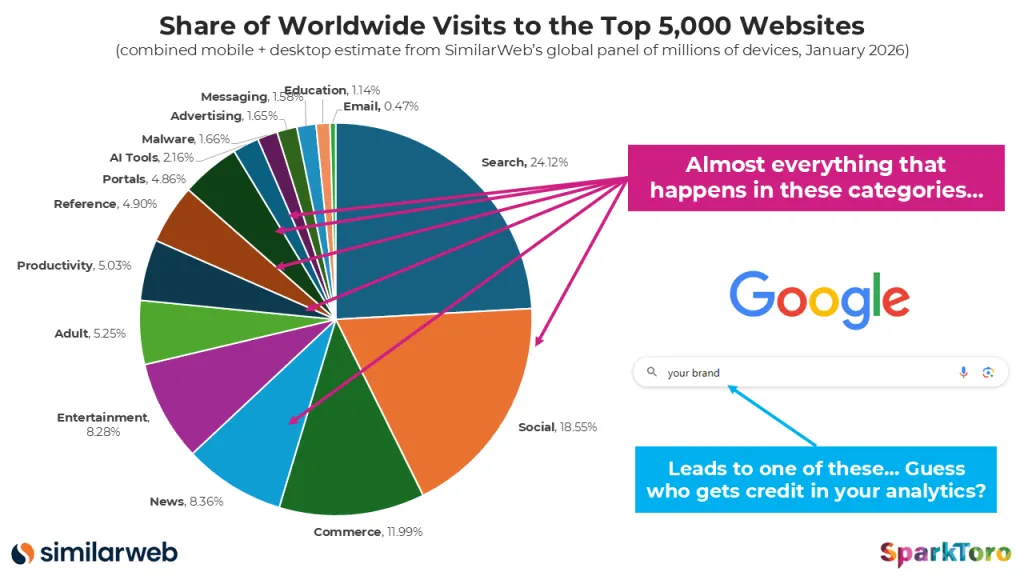
The headline numbers? Search engines account for 24.12% of all web visits. Social networks take 18.55%. Then comes commerce (11.99%), news (8.36%), and entertainment (8.28%). Add it all up and the channels where people discover things, get inspired, and form opinions - the places where influence actually happens -represent over 75% of the web.
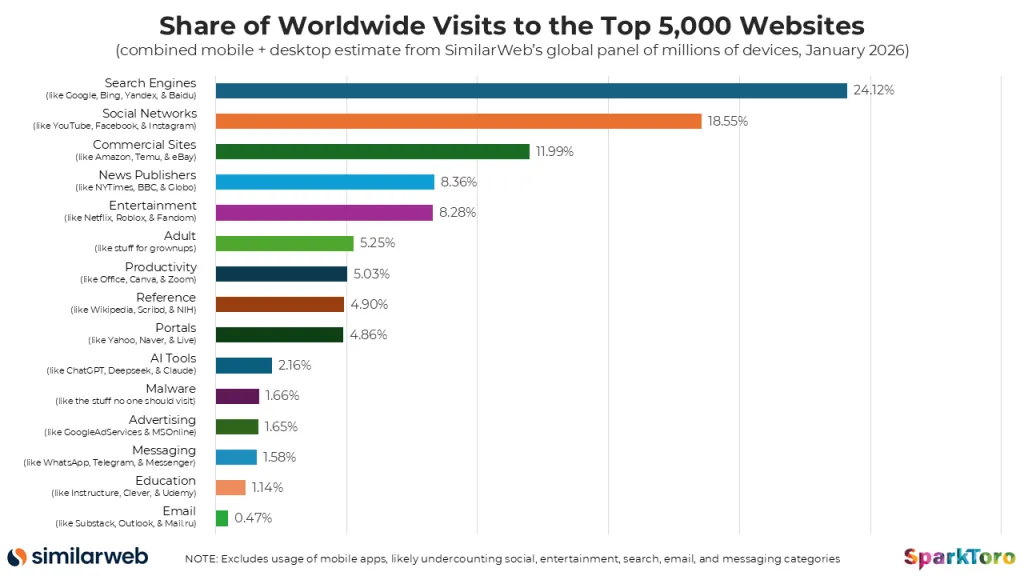
Search is where people go after they've already been influenced.
Fishkin's conclusion is blunt: search is the internet's middleman. It rarely creates demand. It converts interest into answers, navigation, and clicks. And because it sits at the point of conversion, it takes the credit for demand that was created somewhere else entirely.
For anyone working in influencer marketing, this isn't exactly news. But having independent, data-backed validation from a source like SparkToro? That changes the conversation.
Paying more for less
This matters right now because the economics of paid search are getting worse - fast.
Google Ads average cost-per-click climbed to $5.26 in 2025, a 12.9% jump year-on-year according to WordStream's benchmarks. The year before that, cost-per-lead spiked 25%. Contentsquare's data shows a cumulative 30% increase in cost-per-visit over just three years. And in B2B tech? Firebrand's eight-year analysis puts cost-per-conversion at 109% above the historical average.
Meanwhile, paid search bounce rates sit at 59% and conversion rates average just 2%.
Put simply: brands are paying more to reach people who've already made up their minds, in a channel that didn't shape those decisions in the first place.
Where the real returns are
Compare that to what's happening in the creator economy.
Influencer marketing delivers an average return of $5.78 for every $1 spent - nearly three times the $2 return on paid search. The best campaigns regularly hit $11–$18 per dollar. And customer acquisition costs through creator channels often run 30–50% lower than paid advertising.
The market is responding. The global influencer marketing industry hit $32.55 billion in 2025, with 74% of marketers planning to increase their creator budgets this year. Four in five brands held steady or grew their influencer spend, even during broader budget tightening.
As Murray Legg, co-founder of Webfluential, puts it: "Brands have spent a decade optimising for the point of conversion while under-investing in the channels that actually create the demand. The SparkToro data shows that the influence layer - social, content, entertainment, conversation - is where the real work happens. Search just rings the till."
The funnel isn't a funnel anymore
Here's the deeper shift. People don't move neatly through a marketing funnel anymore. They discover a product via a creator on TikTok, discuss it in a WhatsApp group, read about it on a news site, and then maybe Google it. By the time search gets involved, the decision is largely made.
This is why conversational commerce and creator-led affiliate are growing so quickly. They operate in the demand-creation layer, not the demand-capture layer.
WhatsApp alone has over 3 billion active users. Messages on the platform achieve open rates of 98% - compared to email's 20%. The conversational commerce market is projected to grow from $8.8 billion to $32.67 billion over the next decade.
And affiliate marketing - increasingly powered by creator partnerships - has grown 49.8% since 2021 to reach $13.62 billion in the US alone, according to the Performance Marketing Association. Travel brands are seeing $19 in revenue for every $1 invested through affiliate. The smartest brands are now merging their influencer, affiliate, and paid budgets into one unified performance strategy.
The era of siloed marketing is ending. The era of creator commerce is here.
What this means for brands
None of this is to say search doesn't matter. Google alone generates as much traffic as the next 13 largest websites combined. It's massive.
But it's a response mechanism, not an influence mechanism. And if your budget allocation is based on where your traffic appears to come from rather than where demand is actually created, you're systematically over-investing in the middleman.
"The brands we see winning right now are the ones treating creators as strategic partners, not campaign add-ons," says Legg. "They're building long-term relationships, blending influencer content with affiliate mechanics, and meeting their audiences where they already are - in social feeds, in group chats, in the content they consume every day. That's where influence happens. The SparkToro research just proved it at scale."
Whether you're a consumer brand looking to shift spend from paid search into creator partnerships, or a B2B business wondering if influencers really apply to you (they do - 30% of B2B marketers say influencer marketing contributes more to their top-of-funnel goals than paid search), the direction of travel is clear.
Stop optimising for the middleman. Start investing in influence.
Webfluential connects brands with creators who drive the kind of influence that search engines take credit for. Sign up as a marketer to explore how creator partnerships can shift your marketing economics, or join as a creator to start monetising your audience.
Sources and further reading:
Join Webfluential and start growing your business
From micro enterprises to Fortune 500 companies, brands from over 130 countries have booked influencers on Webfluential.